The sticker inside your furnace's blower door tells you more about the filter you can use than any number on a filter box. Look for the line that reads "maximum external static pressure." In most homes it lands near 0.5 inches of water column, and the highest Minimum Efficiency Reporting Value (MERV) rating your furnace can handle is the one that keeps total airflow resistance under that limit.
Don't take your indoor air for granted, and don't take your blower for granted either. A MERV rating chart shows what a filter captures, while that data plate shows how much resistance your system can push air through. The four checks below connect the two, and you can run every one yourself, so your family gets better filtration while your furnace keeps the airflow it was built around.
TL;DR Quick Answers
MERV rating chart
A MERV rating chart ranks air filters from 1 to 16 by how well they capture particles between 0.3 and 10 microns, based on ASHRAE Standard 52.2 testing. Higher numbers catch smaller particles but add airflow resistance, so the best rating for your home is the highest one your furnace’s static pressure limit allows.
MERV 1 to 4: Basic equipment protection that stops lint and coarse dust.
MERV 5 to 8: Standard residential filtration that adds mold spores and pet dander. MERV 8 must catch at least 70% of particles from 3.0 to 10.0 microns.
MERV 9 to 12: Superior residential filtration that reaches finer dust and auto emission particles. MERV 11 is the first rating held to a minimum for the smallest particles.
MERV 13 to 16: Captures most smoke and bacteria, with MERV 13 catching at least 50% of particles from 0.3 to 1.0 microns.
Before you upgrade: Check the maximum external static pressure on your furnace’s data plate. Most homes run efficiently when total system resistance stays at or below 0.4 to 0.5 inches of water column.
Top Takeaways
Static pressure sets your ceiling. Your maximum MERV is the one that keeps total external static pressure within the data plate limit, usually near 0.5 in. w.c.
Your motor type shapes the risk. PSC motors lose airflow under restriction, while ECM motors work harder and can burn out.
Thicker filters buy headroom. A 4- or 5-inch filter can reach a higher MERV with less resistance than a 1-inch filter.
The printed pressure drop matters most. It tells you more about compatibility than the MERV number on its own.
A manometer settles it. One reading confirms whether an upgrade fits your system.
Why Your Furnace Has a MERV Ceiling
Every filter pushes back against the air moving through it. Technicians measure that pushback as pressure drop in inches of water column (in. w.c.), and your blower has a fixed budget for it. The filter is one line item. Ducts and the indoor coil take the rest.
The Pacific Northwest National Laboratory (PNNL) puts the filter's share at 20% to 50% of total resistance and notes that most homes run efficiently at a combined 0.4 to 0.5 in. w.c.
Go over that budget, and your blower motor decides what happens next.
PSC motors, common in older furnaces, can't change speed. Airflow drops and the heat exchanger runs hotter while each heating cycle stretches out.
ECM motors speed up to hold airflow. Your rooms stay comfortable for a while, but the motor draws more power and can eventually burn itself out.
PNNL also warns that too much restriction can overheat a furnace and freeze the evaporator coil once you switch over to cooling.
Reading the MERV Rating Chart Before You Upgrade
ASHRAE Standard 52.2 scores filters from 1 to 16 on their worst performance across three particle size bands: 0.3 to 1.0 microns, 1.0 to 3.0 microns, and 3.0 to 10.0 microns. Grouped into tiers, the chart reads like this.
MERV 1 to 4: Basic equipment protection that stops lint, carpet fibers, and coarse dust.
MERV 5 to 8: The standard residential range, adding mold spores and pet dander. A MERV 8 filter has to catch at least 70% of particles in the 3.0 to 10.0 micron band.
MERV 9 to 12: Superior residential filtration that reaches finer dust and auto emission particles. MERV 11 is the first rating held to a minimum in the smallest band.
MERV 13 to 16: The top of the residential range and beyond. MERV 13 must catch at least 50% of particles from 0.3 to 1.0 microns, which takes in most smoke and bacteria.
The full MERV rating chart with particle-size thresholds for every rating spells out the numbers behind all 16 ratings. Anything labeled 17 to 20 falls outside the ASHRAE standard and describes HEPA-class media, which a standard furnace slot isn't built for. For a lighter starting point, read this overview of choosing filters by MERV rating.
How to Find Your Furnace's Maximum MERV in Four Checks
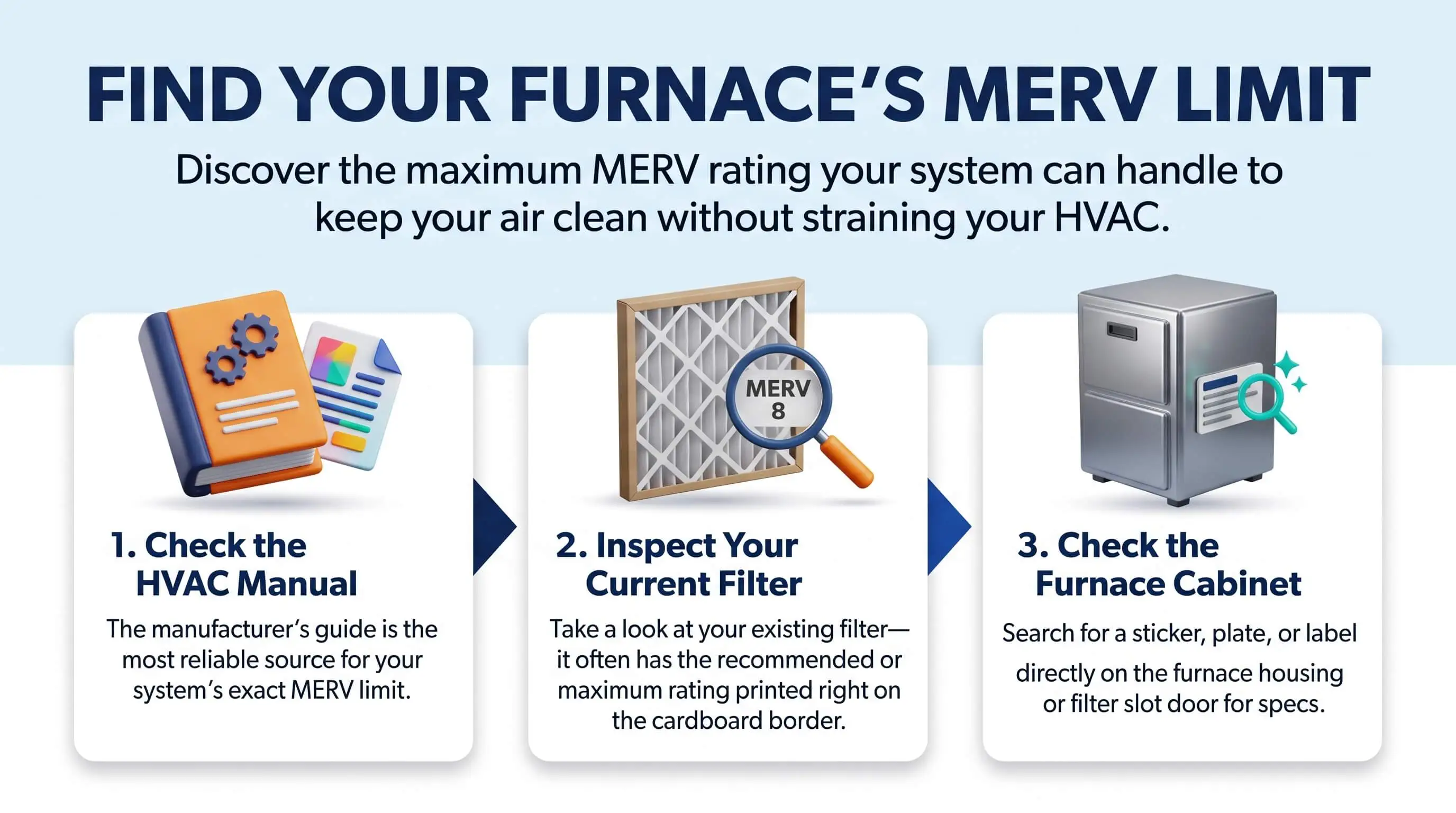
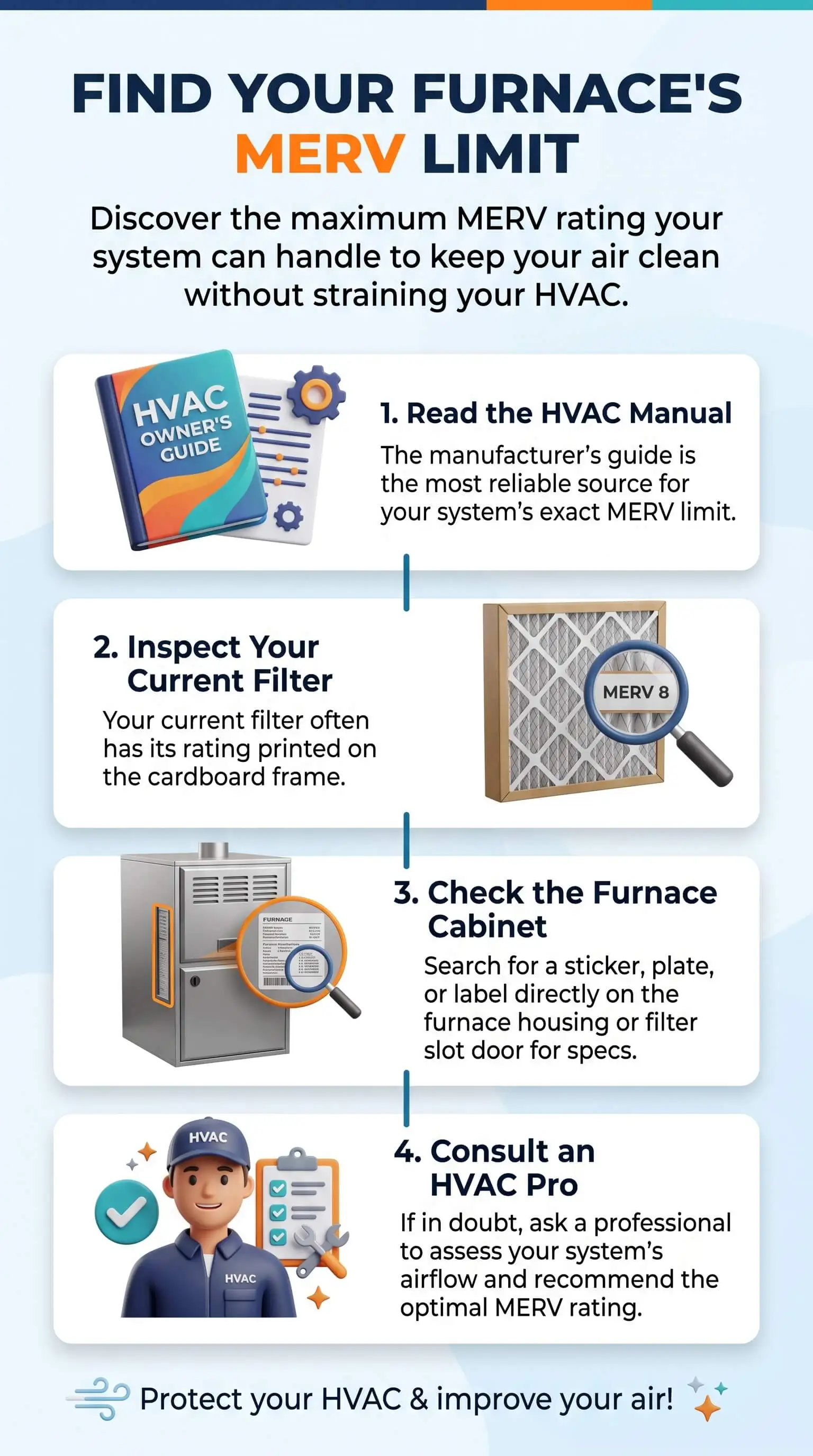
1. Check the Data Plate and Installation Manual
Open the blower door and find the rating label, or look up the installation manual by model number. You're after the maximum external static pressure, plus any approved filter type or MERV limit. When the manufacturer lists a limit, follow it. That's your answer.
2. Identify Your Blower Motor Type
A PSC motor usually has a separate run capacitor wired to it. An ECM motor carries a control module on its body, and its label often says ECM or variable speed. With a PSC motor, play it conservative, because its airflow drops off without a warning sign you'd notice right away.
3. Read the Pressure Drop on the Filter Label
Since April 2019, California has required HVAC filter labels to list MERV, particle size efficiency, and pressure drop at several airflow rates. Many national brands print the same data for their high quality filters. Compare the filter's initial resistance at your system's airflow with what's left in your static pressure budget, and pass on any brand that won't publish the number.
4. Measure Total External Static Pressure
An HVAC technician reads pressure on the supply side and the return side with a manometer, then adds the two. Ask for one reading with your current filter and another with the new one installed. If the new filter pushes the total past the data plate limit, drop one MERV tier or move to a thicker filter.
How Filter Depth Changes Your Safe MERV Limit
Most MERV charts skip this part. Deeper pleats spread the same air across more media, so resistance falls even when the rating stays put.
PNNL documented three MERV 7 filters from one manufacturer, tested at the same air velocity. The 1-inch model measured 0.20 in. w.c., the 2-inch dropped to 0.13, and the 4-inch came in at 0.12. So a 1-inch MERV 13 that strains your blower may run comfortably as a 4- or 5-inch media filter. Measure your slot before you buy. This guide to standard furnace filter sizes covers the common options.
Warning Signs You've Gone Past Your Furnace's Limit
Weaker airflow at the registers farthest from the furnace
Longer heating cycles, or rooms that never reach the thermostat setting
A whistle at the return grille, or a filter bowing inward
The furnace shutting down on its high-limit switch, then restarting
Ice on the indoor coil or refrigerant lines during cooling season
After an upgrade, any one of these is reason enough to put your previous filter back and book a static pressure reading. For a closer look at how that damage builds, read what high MERV filters can do to a furnace.
When You Need More Filtration Than Your Furnace Allows
A tight static pressure budget still leaves room for cleaner air. A contractor can install a 4- or 5-inch media cabinet, which adds surface area without adding much resistance. An enlarged return filter box holding two filters side by side does the same job, sized to your system with ACCA Manual D.
Then there are the bedrooms, where your family spends the most hours. A portable HEPA air cleaner there adds filtration without touching your furnace at all. And if your four checks show headroom, this guide to choosing a MERV 13 furnace filter covers what to buy next.
"In my experience running static pressure tests on older furnaces, the 1-inch filter slot is usually the bottleneck, not the blower. When a homeowner asks for MERV 13, I measure first. More often than not, the fix is a deeper filter rack instead of a lower rating. The number on the box tells you what a filter catches, and the manometer tells you whether your system can live with it."
Essential Resources
ASHRAE Filtration and Disinfection FAQ. The group behind MERV sets MERV 13 as its baseline while telling you to weigh what your system can handle. ashrae.org
ACCA Manual D Residential Duct Systems. The standard contractors use to size ducts and budget for filter pressure drop. acca.org
AHRI Standard 680. How residential filters get rated for resistance, particle removal, and dust-holding capacity. ahrinet.org
NAFA Understanding MERV. A plain-language walkthrough of how ASHRAE 52.2 testing turns lab results into a MERV number. nafahq.org
ENERGY STAR Maintenance Checklist. Monthly filter inspections, and why a dirty filter drives up costs and damages equipment. energystar.gov
CDC Ventilation FAQ. The CDC recommends MERV 13 filters or the highest efficiency your system can take. cdc.gov
American Lung Association: Air Cleaning. A central filter upgrade weighed against portable HEPA units. lung.org
Supporting Statistics
0.4 to 0.5 in. w.c. Most residential HVAC systems run efficiently when total pressure drop stays at or below this range, and the filter alone accounts for 20% to 50% of it. basc.pnnl.gov
About 45%. Space heating eats roughly 45% of home energy bills, so a restricted furnace hits your budget where it's heaviest. energy.gov
0.3 to 10 microns. MERV ratings measure capture across this particle size range, and the EPA advises picking the highest rating your system fan and filter slot can accommodate. epa.gov
Final Thoughts and Opinion
I'd skip the hunt for the highest MERV on the shelf. Aim instead for the highest MERV your static pressure budget allows, and expect that number to change from house to house. The EPA says most furnaces can accommodate MERV 13, which is good news for a lot of families. Still, a 1-inch slot feeding a PSC blower has far less headroom than a 4-inch media cabinet on a variable-speed system.
Run the four checks once and the guesswork goes away. Cleaner air for your family and steady airflow for your furnace with the right pleated furnace filter is a trade worth making.
Frequently Asked Questions
Is MERV 13 Too High for My Furnace?
Usually not. The EPA says most furnaces can accommodate a MERV 13 filter without equipment problems. Double-check if you have a 1-inch slot and a PSC blower, since that pairing has the least headroom.
Can a High MERV Filter Damage a Furnace?
It can, once the filter's pressure drop exceeds what your system can handle. Too much restriction can overheat the furnace, freeze the evaporator coil, and wear out or burn out the blower motor.
Does Filter Thickness Affect the Maximum MERV?
Yes. Deeper pleats add surface area and lower resistance, so a 4- or 5-inch filter can often run a higher MERV than a 1-inch filter in the same furnace.
Does the MERV Rating Chart Go Above 16?
The official ASHRAE scale stops at 16. People use 17 to 20 informally to describe HEPA-class media, which usually puts too much resistance on a standard furnace.
How Often Should I Change a Higher-MERV Filter?
Check it every month and replace it once it looks loaded. Higher-MERV media fills up faster, and a clogged filter restricts airflow more than a clean one at any rating.
Find Your Furnace's Maximum MERV Before You Buy
Check your data plate and motor type, then compare the pressure drop on your next filter with the room your system has left, using MERV, MPR, and FPR ratings to assess your filtration options. It's a little effort with a big impact, and it gets you the cleanest air your furnace can deliver from a blower that keeps running the way its maker intended.