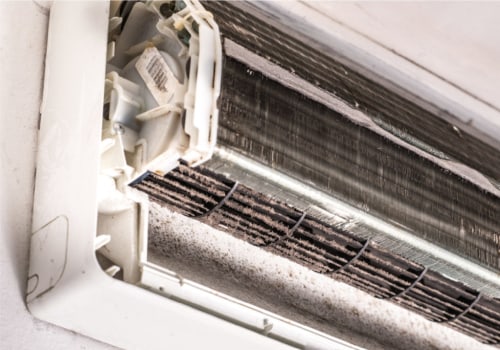
Good news. 14x30x1 is a real residential size, and the homes that use it are not outliers. They are families whose HVAC systems were built around a 14-inch by 30-inch return opening, often in builds served by Carrier, Lennox, Trane, Goodman, Rheem, or American Standard. You are not stuck with a special order, and your old frame is not a mistake.
This page shows how a 14x30x1 HVAC home air filter can support cleaner air, which systems use this size, how to confirm the fit yourself in under five minutes, and what to check before you reorder with confidence.
TL;DR Quick Answers
14x30x1 HVAC home air filter
A 14x30x1 HVAC home air filter is a legitimate residential size built for forced-air systems with a 14-inch by 30-inch return-air opening. Nominal size reads 14 by 30 by 1 inches. Actual size runs roughly 13.5 by 29.5 by 0.75 inches to fit cleanly inside a standard 1-inch housing without gaps.
Where it fits: homes served by Carrier, Lennox, Trane, Goodman, Rheem, American Standard, and older regional builds with longer return grilles.
MERV options: MERV 8 for standard homes, MERV 11 for pets and allergies, MERV 13 for smoke, bacteria, and virus-carrying particles.
Replacement frequency: every 60 to 90 days in a typical household, sooner with pets, allergies, smokers, or wildfire smoke events.
How to confirm fit: measure the filter slot opening, not the old filter frame, on all three axes.
Why it is hard to find locally: big-box retailers stock the top five sizes only. 14x30x1 sits just outside that list, so most homeowners order directly from a manufacturer that runs the size on a regular production schedule.
14x30x1 is not a special order. It is a standard residential size, and the homes that use it deserve the same next-day access to quality air protection as any other household on the block.
Top Takeaways
14x30x1 is a real residential filter size used by specific HVAC configurations across Carrier, Lennox, Trane, Goodman, Rheem, American Standard, and older regional builds.
Nominal size is 14 by 30 by 1 inches. Actual size runs roughly 13.5 by 29.5 by 0.75 inches.
Always measure the filter slot itself, not just the old filter frame. The slot is the source of truth.
MERV 8, 11, and 13 are all available in this size. Choose based on what your household actually needs, not just price.
Replace every 60 to 90 days under typical conditions. Shorter intervals with pets, allergies, smokers, or dusty environments.
A clean 14x30x1 can cut HVAC energy use by 5 to 15 percent compared to a clogged one.
What a 14x30x1 Air Filter Actually Is
A 14x30x1 air filter is a flat, rectangular panel that sits on the return side of a forced-air HVAC system. The three numbers are the nominal dimensions in inches: 14 tall, 30 wide, 1 deep.
Actual size runs smaller. Most 14x30x1 filters come in at roughly 13.5 by 29.5 by 0.75 inches, and that gap is intentional. Manufacturers trim a quarter inch on every axis so the filter slides into a standard 14-by-30 housing without binding, and so air cannot slip around a too-tight frame.
After manufacturing filters for over a decade, we have watched this tiny gap confuse thousands of homeowners looking for the best air filter for dust. You measure the frame, see 13.5 by 29.5, and assume the last filter was the wrong size. It was not. That is how pleated residential filters are built, and we make them to that spec because it works.
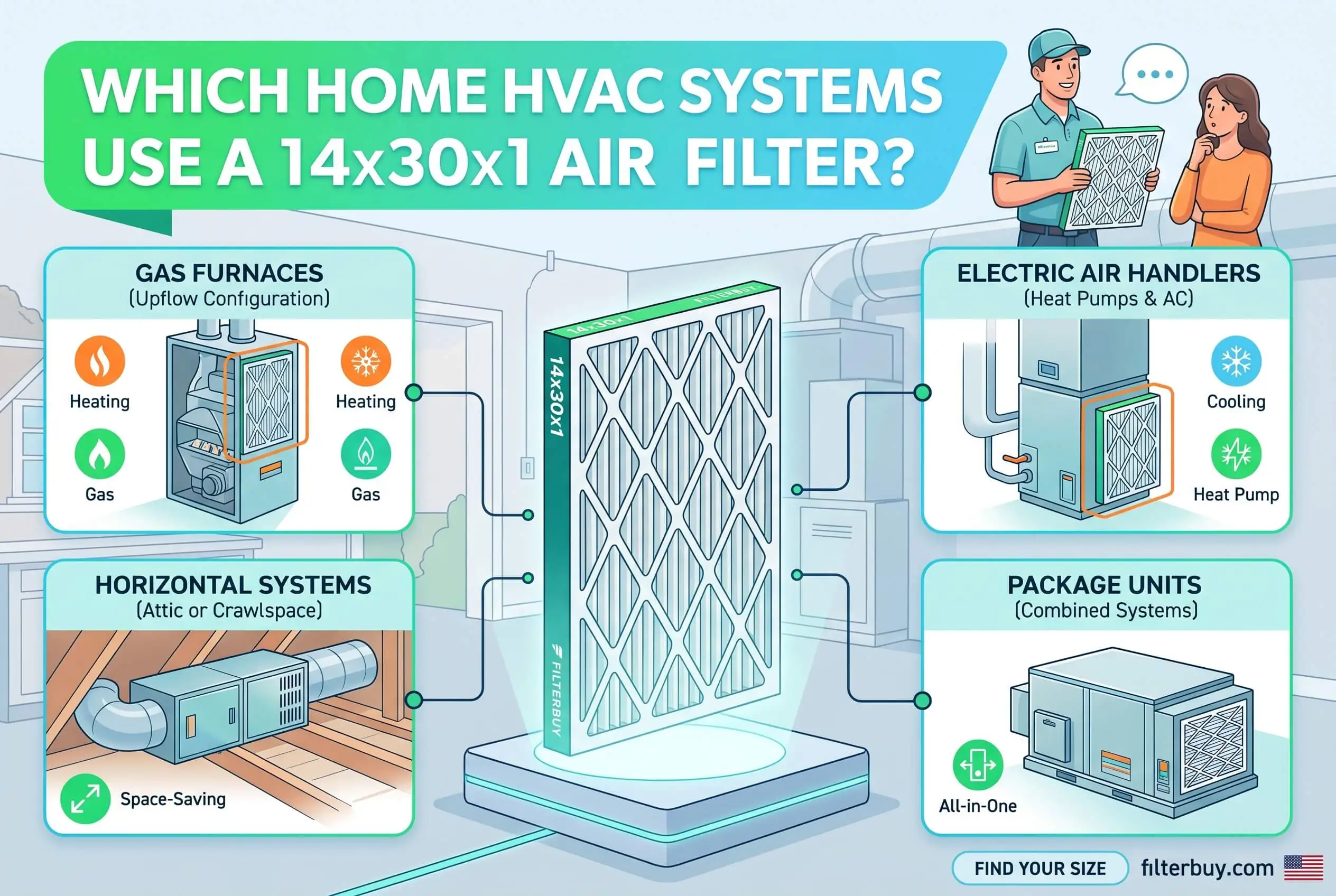
Home HVAC Systems That Commonly Use This Size
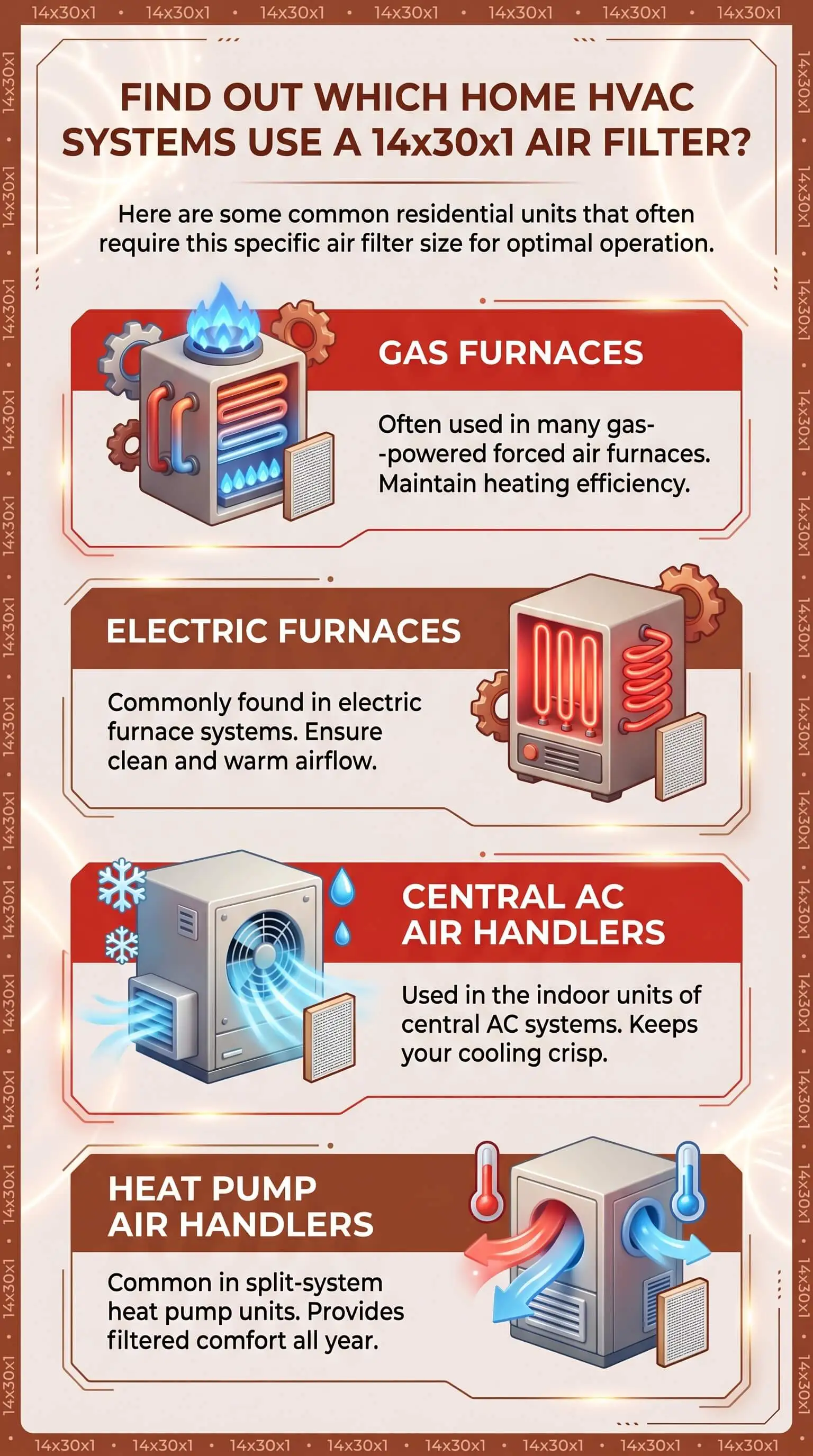
No brand builds only for one filter size. Residential HVAC units are designed around the return-air opening of the home they serve, so the same furnace model can take a 16x25x1 in one house and a 14x30x1 in another. Here is where 14x30x1 tends to show up.
Carrier, Bryant, Payne: Mid-sized split systems and gas furnaces installed in homes with longer return grilles, especially ranch-style layouts and 1990s-to-2000s builds.
Lennox, Armstrong, Ducane: Upflow and downflow furnaces paired with horizontal return drops, where builders chose a 14x30 opening to fit a narrower mechanical closet.
Trane, American Standard: Variable-speed air handlers in homes with a single centralized return. The long, narrow slot handles higher CFM without choking airflow.
Goodman, Amana, Daikin: Builder-grade split systems in new-construction tract homes across the South and Southwest, where 14x30 was a common spec.
Rheem, Ruud, Weatherking: Heat pumps and gas furnaces in two-story homes where the return sits in a hallway ceiling and the opening was sized to the joist spacing.
Older custom and regional builds: Homes built before filter sizes were standardized, plus custom ducting in additions and remodels. 14x30x1 appears here because the builder sized the grille to the wall cavity, not to a filter.
Model numbers shift every few years, and a single brand might specify a different filter size for two otherwise identical units depending on where they were installed. Use the list above as a starting point for filter replacement. The only answer that holds across every brand is the one your tape measure gives you.
Why 14x30x1 Is Less Common but Far from Rare
The residential filter industry leans on five workhorse sizes: 16x20x1, 16x25x1, 20x20x1, 20x25x1, and their 4-inch cousins. Those cover most systems in most homes built over the last 25 years, which is why big-box shelves rarely stock anything else.
14x30x1 sits just outside that top five. We manufacture it daily at our American facilities because a meaningful number of families still need it, and treating their size as a special order would be wrong. Your home deserves the same quality air protection as any other on the block, regardless of what your return happens to measure.
How to Confirm Your System Really Uses a 14x30x1
Spend five minutes with a tape measure before you reorder. This is the single most effective way to avoid buying the wrong size and paying for a filter that will not protect your home the way it should.
Power the HVAC system off at the thermostat. Set it to Off, not Auto.
Find the filter slot. On most systems, you will find it behind the return grille in a hallway or ceiling, or in a slot on the side of the air handler.
Slide the old filter out and record the nominal size printed on the frame.
Measure the slot opening, not the old filter. The slot tells you what your system was built for. The old filter tells you only what the last owner bought, which is not always the same thing.
Record length, width, and depth. You are looking for roughly 14 by 30 by 1 inches on the slot, with the actual filter coming in slightly smaller.
Check the airflow arrow on the old filter and on the duct wall. Note the direction so you install the new one the same way.
Signs Your System Was Designed for a 14x30x1
The return grille is visibly longer than a standard 20x25 or 16x25 opening. Most 14x30 returns look narrow and tall or wide and short depending on orientation.
The old filter frame sat flush against the slot with no gaps along the edges. A correctly sized filter should not bow, flap, or need tape to stay put.
The filter did not bend inward under airflow. Bowing usually means the filter is too thin for the slot or rated for a higher MERV than the system is designed to pull.
Your HVAC install paperwork or home records reference 14x30 or 14x30x1 on the filter callout.
You have replaced the filter before with a 14x30x1 and it worked. Homeowners often second-guess themselves after a cheap filter is bowed or torn, but a quality 14x30x1 should sit flat through a full 60-to-90-day cycle.
"We see the same pattern with 14x30x1 every week on our production line, especially when comparing types of air filters. A homeowner is convinced their system needs a custom cut, and nine times out of ten we are already making their filter in bulk. The size is real, the demand is steady, and the families who need it deserve the same next-day availability as any 20x25x1 on a big-box shelf. That is why we treat 14x30x1 as a regular size, not a favor."
7 Essential Resources
We built this list for homeowners who want to see past the filter frame and understand the bigger picture. Each resource below is published by a federal agency or a national nonprofit, and each link points to the specific page we rely on when customers ask us hard questions.
Understand What Filtration Actually Does in Your Home
The EPA's consumer guide walks you through how furnace and HVAC filters fit into a broader indoor air strategy. The short version is that source control and ventilation come first, and filtration is the supplement that catches what is left. This is the page we send homeowners who are weighing a filter upgrade against other changes.
Source: EPA — Guide to Air Cleaners in the Home
Learn Why Indoor Air Deserves Your Attention
The EPA's indoor air quality overview spells out what builds up inside a typical home and why those concentrations often run higher than what you breathe outdoors. Read it alongside your filter choice and you will have a clearer picture of exactly what your 14x30x1 pleats are capturing every time the blower kicks on.
Source: EPA — Indoor Air Quality
Maintain Your Air Conditioner the Right Way
The U.S. Department of Energy's air conditioner maintenance page is the practical counterpart to the EPA's health guidance. It covers filter replacement frequency, coil care, and the small habits that keep a system from drifting out of spec over a long cooling season.
Source: U.S. Department of Energy — Maintaining Your Air Conditioner
Run Your HVAC System More Efficiently
ENERGY STAR's Heat and Cool Efficiently guide pairs filter maintenance with sealing, insulation, and thermostat habits. Worth reading if you are already swapping your 14x30x1 and want to squeeze more comfort out of the system you already own.
Source: ENERGY STAR — Heat and Cool Efficiently
Improve Ventilation Alongside Filtration
The CDC's ventilation guidance lays out the five-air-changes-per-hour benchmark and the role MERV-13 filtration plays in a layered strategy against respiratory viruses and indoor contaminants. If you are weighing a higher-MERV 14x30x1, skim this one first.
Source: CDC — Ventilation in Buildings
Build a Healthier Home if You Have Asthma or Allergies
The Asthma and Allergy Foundation of America covers the full allergy-friendly home strategy, with HVAC filtration as one of several levers you can pull. If anyone in your household has asthma, eczema, or seasonal allergies, the context here will help you choose between MERV 8, 11, and 13 with more than a gut call.
Source: AAFA — Why Healthy Indoor Air Quality Is Important
See the Research Behind Indoor Air Risk
NIEHS summarizes the peer-reviewed research on indoor air pollutants and their health effects, from mold and VOCs to combustion byproducts. This is the resource we point to when a customer reasonably asks whether filter choice matters at all.
Source: NIEHS — Indoor Air Quality
3 Supporting Statistics
Three numbers worth holding in your head before you order your next 14x30x1. Every figure below traces to a federal or national-nonprofit page we have read in full.
90 Percent of Your Time Is Spent Indoors
The EPA reports that Americans spend about 90 percent of their time indoors. That includes sleep, work, meals, and the hours most of us never count because we are just living our lives. This is the number that anchors everything we do at Filterbuy. If 90 percent of your breaths happen inside, the filter in your return vent is quietly doing a job worth getting right.
Source: EPA — Indoor Air Quality
Indoor Pollutant Levels Can Run 2 to 5 Times Higher Than Outdoor Levels
The EPA also reports that concentrations of some indoor pollutants often run two to five times higher than typical outdoor concentrations, and occasionally more than 100 times higher. The number tends to surprise homeowners who assume indoors is the safer place by default. Most of what the 14x30x1 captures is invisible to the naked eye, which is exactly why a properly sized filter with the right MERV rating matters.
Source: EPA — Inside Story: A Guide to Indoor Air Quality
A Dirty Filter Can Raise HVAC Energy Use by 5 to 15 Percent
Swapping a clogged filter for a clean one can lower air conditioner energy use by roughly 5 to 15 percent, according to the U.S. Department of Energy. That range matters because HVAC is already the biggest single line item on most household utility bills. Replacing a tired 14x30x1 with a fresh one is one of the cheapest efficiency upgrades a homeowner can make, and it also protects the blower motor, evaporator coil, and ductwork sitting behind the filter.
Source: U.S. Department of Energy — Maintaining Your Air Conditioner
Final Thoughts and Opinion
Filter sizing looks trivial from the outside and costs real money when it goes wrong. A 14x30x1 that does not match the slot leaves gaps. Gaps let unfiltered air slip past the pleats and loop back through the supply side, carrying dust, dander, and pollen right back into the rooms where your family breathes. The system works harder. The coils get dirtier. The utility bill creeps up. None of it is dramatic, and that is what makes it easy to miss.
Our view at Filterbuy is simple. Every household deserves the right filter for the system they actually own, not just the five sizes that fit neatly on a big-box endcap. 14x30x1 belongs on that list. We run this size through our American production facilities every day because the homes that use it are families, and their air is just as worth protecting as anyone else's. That is what Better Air For All actually means to us.
Frequently Asked Questions
Q: Is 14x30x1 a standard air filter size?
A: It is not one of the top five most common residential sizes, but it is a legitimate standard size. Homes with longer return-air grilles built around a 14-by-30-inch opening use it, and it ships in pleated MERV 8, MERV 11, and MERV 13 options from most direct manufacturers.
Q: What does the 1 in 14x30x1 mean?
A: The 1 is the nominal depth of the filter in inches. Actual depth is closer to 0.75 inches. The quarter-inch difference is intentional and keeps the filter seated in a standard 1-inch housing without binding.
Q: Can I use a 14x25x1 or a 16x30x1 filter instead?
A: No. A filter that does not match the slot leaves gaps around the frame. Air takes the path of least resistance, which means it skips the filter, carries dust straight into the evaporator coil, and circulates back through the supply registers unfiltered. If you are truly stuck, a custom-cut 14x30x1 ships faster than most people expect and solves the problem the right way.
Q: What MERV rating should I pick for a 14x30x1 filter?
A: MERV 8 handles dust, pollen, and lint for standard residential use. MERV 11 steps up to pet dander, mold spores, and finer household particles, which makes sense in allergy-sensitive homes. MERV 13 captures smoke, bacteria, and virus-carrying aerosols, and the CDC recommends it where a system can support the higher static pressure. Check your unit's rated static pressure before going above MERV 11.
Q: How often should I change a 14x30x1 filter?
A: Every 60 to 90 days in a typical household. Every 6 weeks with asthma, severe allergies, or indoor smokers. Every 2 months with pets. Every 30 days during wildfire smoke events or heavy construction nearby. Check it monthly through peak heating and cooling season, and replace it the moment it looks gray or dusty.
Q: Why can't I find 14x30x1 filters at my local hardware store?
A: Big-box retailers stock the sizes that move fastest, which is a short list of five or six standard dimensions. 14x30x1 falls just outside that window. Direct manufacturers like Filterbuy carry it on a normal production schedule, ship in 24 hours, and treat it as a regular size rather than a special order.
Q: Does a 14x30x1 filter reduce HVAC airflow?
A: Every filter creates some static pressure drop. A properly sized 14x30x1 with the right MERV for your system will not starve the blower. Problems show up when a homeowner installs MERV 13 in a system designed for MERV 8, or when the filter stays in place long past its replacement window and clogs. Match the MERV to the system spec and replace on schedule.
Ready to Order the Right 14x30x1?
Once you have measured the slot and confirmed the size, the rest is easy. A properly sized 14x30x1 replacement filter ships within 24 hours from our U.S. manufacturing facilities in MERV 8, 11, 13, and odor-eliminator options, with quantity discounts built in. Better Air For All is not a slogan for us. It is why we build this size every day, for the families who have been told their size is a special order.